

A water well drilling equipment package can involve the rig, method-specific tools, air or fluid-circulation equipment, connections, handling items and documents. Which items are included, optional or supplied by the customer must be stated in the written offer. There is no single equipment list that automatically fits every water well task.
The purpose of a package review is to make the system and responsibilities clear. A buyer should be able to identify each necessary function, the equipment assigned to it and who provides that equipment. This guide explains the main groups and shows how to turn a broad phrase such as “complete drilling package” into a usable supply description.
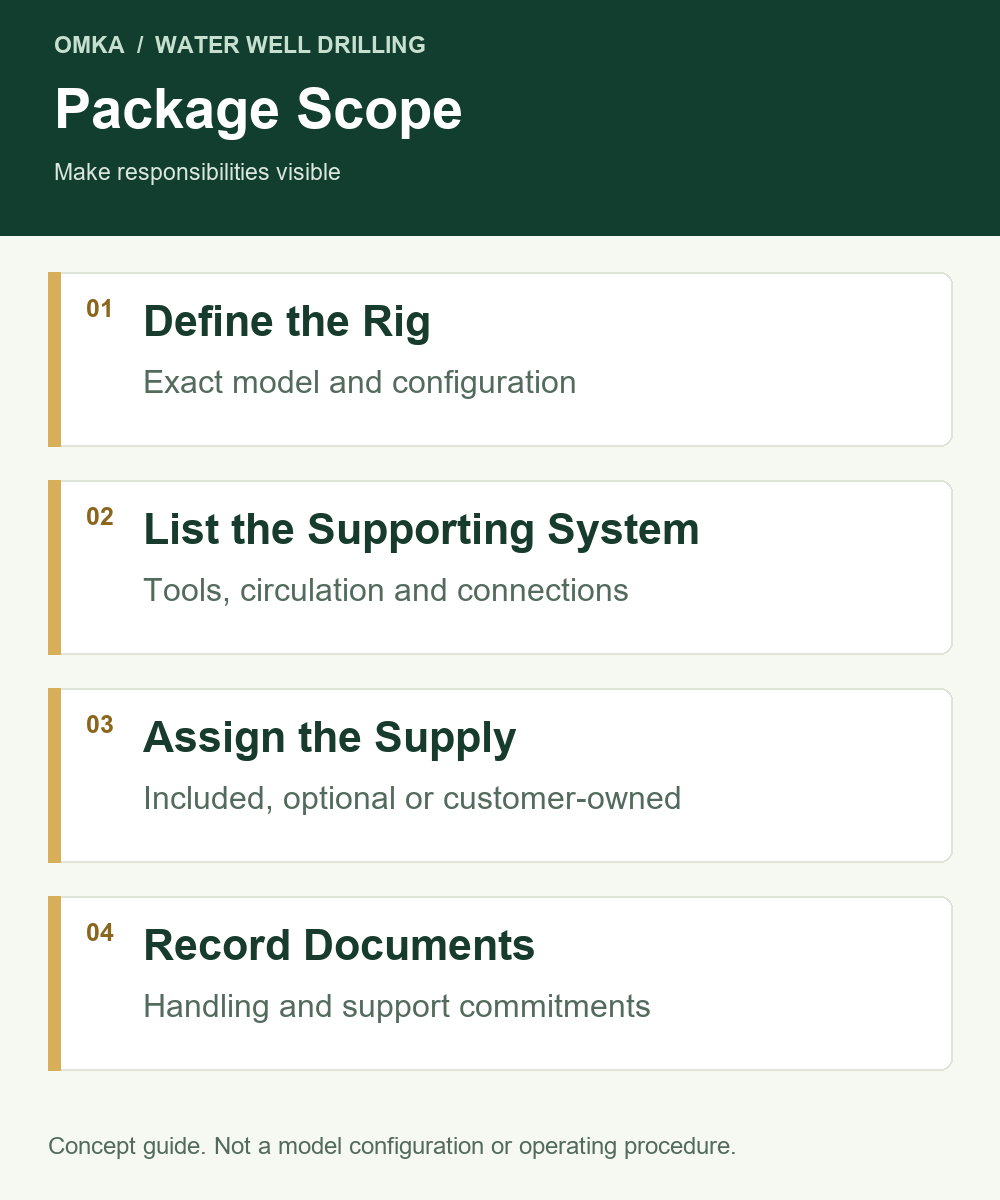
Distinguish the Rig From a Complete Water Well Drilling System
The rig provides functions such as rotation, feed, lifting and tool handling according to its documented configuration. Those functions are essential, but they do not identify every tool or circulation component required for the selected method.
A complete-system discussion also includes the drilling assembly and the supporting medium. A DTH arrangement, for example, needs an identified hammer and air supply. A fluid-circulation arrangement requires the appropriate tools, pump and associated system. The package definition follows the task rather than the appearance of the main machine.
“Complete” should therefore describe an agreed boundary. It can mean that the offer covers the listed drilling equipment while the customer supplies specified site arrangements. It should not imply that every possible item or every service associated with a finished water well is included.
Product photographs are useful for recognising equipment, but they do not define the contract. An accessory shown on a display machine may be optional, belong to a different configuration or be outside the quoted quantity. Use an itemised scope to establish what is supplied.
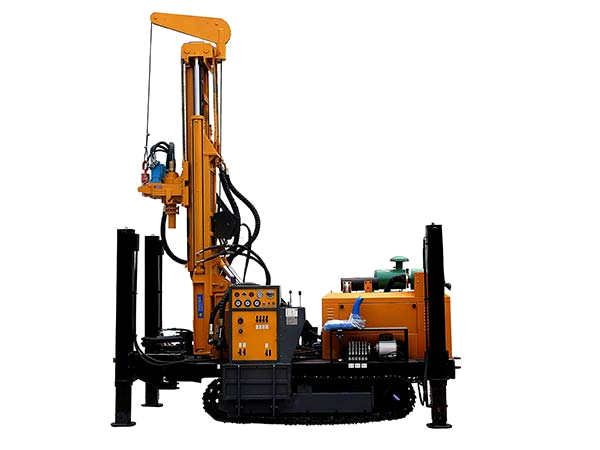
Define the Main Rig and Supporting Equipment
Rig, Drive and Platform
Identify the rig category, model and offered configuration. Include the relevant power arrangement, platform, method support and agreed accessories. A shortened model designation can be insufficient where the same number appears in different product categories.
The task should explain why that configuration is being reviewed. Target depth, borehole dimensions, formation information and site conditions help the buyer and supplier discuss the same requirement. The machine specification and the task description belong together.
Options need their own entries. If several engine or handling arrangements are available, the offer should identify the selected one. Listing every possibility in a brochure does not establish that the buyer receives them all.
Air or Fluid-Circulation Equipment
For an air-drilling package, identify the compressor and relevant rating information, then connect it to the selected tools and distribution arrangement. Working pressure, airflow basis and site conditions should be clear enough for a documented review.
For a fluid-circulation package, identify the pump and the intended duty, drive and connections. The supply and return arrangements may involve additional equipment or customer responsibilities. A pump-only line should not be read as confirmation of an entire circulation installation.
Where equipment supports more than one arrangement, define the actual supplied scope for each. Documented method capability and included package contents are separate fields. A buyer needs both to understand the offer.
The practical benefit of reviewing auxiliary equipment early is that scope questions can be resolved before pricing is finalised. It is harder to compare proposals when the compressor, pump or connections are left as unspecified future purchases.
List the Drilling Tools, Connections and Handling Items
Drill Rods and Bottom Tools
The proposed drill string needs more detail than “drilling tools included.” Record the rods, relevant dimensions and connection specifications, as well as the selected bit, hammer or other method-specific tools. Quantities should correspond to the agreed scope.
Tool sizes and model-family names do not always define interfaces. Drawings and accurate component identification help establish whether the assembly matches the rig and supporting system. Similar photographs are not compatibility evidence.
Casing-related equipment should be listed where it forms part of the agreed task and supply. The package should distinguish the casing itself, any relevant tools and the responsibilities associated with the project design. Avoid treating every water well as requiring the same casing-drilling arrangement.
Connections and Distribution
Hoses, fittings, adapters and other connections may seem minor compared with the rig, yet they join the supplied components. A package can remain incomplete at an interface even when all the large machines have been ordered.
Record what each connection joins, its relevant specification and the supplier responsible for it. This is especially helpful where the contractor is combining new equipment with existing components. It also prevents each supplier from assuming that another party will provide an unlisted adapter.
The required details depend on the system. Air-distribution ratings and connections differ from a fluid-system scope. The offer should describe the actual arrangement rather than use one generic accessory label for both.
Handling and Supporting Items
Handling equipment must be considered with the intended rods, tools and machine configuration. Some items may be part of the rig; others may be agreed options or customer-provided equipment. Identify them without converting a general list into a promised standard package.
A handling feature should also be accompanied by the relevant documentation. A catalogue mention of a winch or mast function does not define every loading or field-handling operation. Purchasing descriptions should clarify equipment and instructions, not invent operating procedures.
Identify Equipment Supplied by the Customer
Existing equipment can reduce the new purchase scope, but it still belongs in the technical review. A customer-owned compressor, pump or tool must be identified by its actual model and available documents. Ownership alone does not establish suitability.
Record the condition and configuration information relevant to the assessment. For example, a model name without its rating basis or connection details may leave important matching questions open. The buyer should provide what is known and identify the missing records.
Customer-supplied site items need a similarly clear boundary. Transport, lifting arrangements, water or fluid supply and other agreed responsibilities should be assigned explicitly. The supplier and buyer should not rely on different interpretations of a word such as “installation.”
A useful proposal shows the entire equipment relationship while distinguishing commercial ownership. A component can be excluded from the new purchase price and still be essential to the system. This distinction makes the package more transparent.
Include Documents, Support and Explicit Exclusions
Documents should relate to the supplied configuration. Relevant manuals, component identification and packing information help the customer receive and manage the equipment. The offer should identify which documents accompany the order and in what agreed form.
Support commitments also require written scope. Training, warranty, technical assistance and service responsibilities should follow confirmed terms. A legacy brochure or a competitor’s offer is not evidence of the support provided with the current package.
For training, useful purchasing questions concern the intended participants, equipment configuration, delivery method and agreed content. For warranty, the buyer needs the actual coverage, conditions and exclusions. These are commercial commitments to establish, not advantages to invent for a marketing article.
Explicit exclusions are helpful when they prevent a gap in expectations. The offer can state that specified transport, site work or customer-owned equipment is outside the supplied package. The buyer can then plan those items rather than assume the word “complete” covers them.
Keep the distinction between drilling equipment and well-project services visible. Supplying a drilling package does not automatically include water-resource assessment, well completion design or every local project requirement. The written agreement should define the relevant boundary.
Use a Written Package-Scope Table
A scope table connects the equipment list to responsibilities. For each item, record identification, quantity or agreed range, supply status, interface documents and unresolved questions. Its value comes from those details, not merely the number of rows.
Swipe or scroll the table to compare all columns.
| Item Group | Identification Needed | Supply Status | Key Question |
|---|---|---|---|
| Rig | Category, model and configuration | Included or separately quoted | Which unit is being supplied? |
| Circulation equipment | Unit and relevant duty documents | Included, optional or customer-owned | What supporting arrangement is assessed? |
| Drilling tools | Models, dimensions and connections | Agreed quantities and responsibility | What forms the connected drilling assembly? |
| Distribution and adapters | Relevant interfaces and ratings | Named supplier or customer item | Who provides each connection? |
| Handling items | Actual configuration and documents | Base, option or customer-provided | What supports the planned arrangement? |
| Documents and support | Specific contents and written terms | Agreed scope | What accompanies and supports delivery? |
Use the table as a working document. When a supplier changes an option, update the affected equipment and interface rows. A revised compressor or tool may create a new document requirement even when the main rig remains unchanged.
The table also makes quotation comparisons easier. Two offers can be checked against the same scope rather than judged from different assumptions. Where an item is unresolved, show it plainly instead of placing “included” beside a vague description.
How the Scope Table Works in Two Purchasing Situations
Consider a contractor buying a rig while retaining documented tools and a supporting unit. The scope review should identify the new rig configuration and assess its relationship with the retained equipment. The excluded purchase items remain visible as customer-supplied components.
Now consider a buyer starting with no identified equipment and requesting a wider system. The table must define the proposed tools, circulation equipment, connections and handling items alongside the rig. The supplier’s offer should make the assumed task and package boundary clear.
These are hypothetical purchasing situations. Neither proves that one approach is cheaper or more suitable. They show why the same phrase “water well package” can describe different responsibilities and why a written scope is necessary.
The buyer should also use the table when several suppliers are involved. Assign the responsibility for the connecting information, not just the large machines. Otherwise, separate correct component orders can still leave an unresolved system interface.
Quantities Need the Same Clarity as Model Names
Even correctly identified components can leave a scope gap if the quantity is unspecified. The buyer should understand whether the offer covers one identified item, a documented set or a quantity still to be agreed.
Keep quantities tied to the task and configuration. A rod or tool list copied from another project may not describe the current borehole plan. Where the quantity depends on information still under review, state that dependency in the offer rather than present a fixed number as confirmed.
This makes receipt checking more practical. The packing record can be compared with the agreed scope item by item, and any difference can be discussed using the same identification and quantity information.
Common Package-Purchasing Omissions
One omission is buying enough named machines without defining their connections. The solution is to identify interfaces and responsibilities in the scope, using the relevant documents.
Another is assuming every catalogue option is included. Record the selected configuration and quantities. A list of available accessories is not a packing list.
A third is excluding existing equipment from the review because it is already owned. Its compatibility and documents still affect the package.
A fourth is leaving support terms to informal expectations. Written training, warranty and documentation scope is easier to compare and manage than a general assurance of “full support.”
Finally, avoid confusing equipment completeness with guaranteed well results. A package can be clearly defined while the water resource and well design still require separate project information.
Conclusion
A water well drilling equipment package is best understood as an agreed system and supply boundary. The rig, tools, circulation equipment, interfaces, handling items and documents should each have a clear description and responsible party.
Use an itemised scope to turn general package language into a practical purchasing record. It makes omissions visible and gives suppliers and customers a common basis for technical and commercial discussion. The water well rig enquiry guide can help prepare the initial task, while the tool connections guide supports the interface discussion.
Share your existing equipment list and requested supply scope through our contact page so we can review the proposed water well drilling package.