

In water well DTH drilling, pressure and airflow describe different parts of the air supply. Pressure must be considered against the hammer’s operating requirements and the system conditions. Airflow describes the supply of air on a stated rating basis and must be reviewed for the selected tool and circulation task. One number cannot replace the other.
A useful purchasing comparison therefore connects the compressor, air distribution, drill string and DTH tools. It asks what the equipment can provide under the relevant conditions, rather than choosing from the largest pressure or flow figure in a catalogue. This guide explains how to read those fields and organise a practical system review.
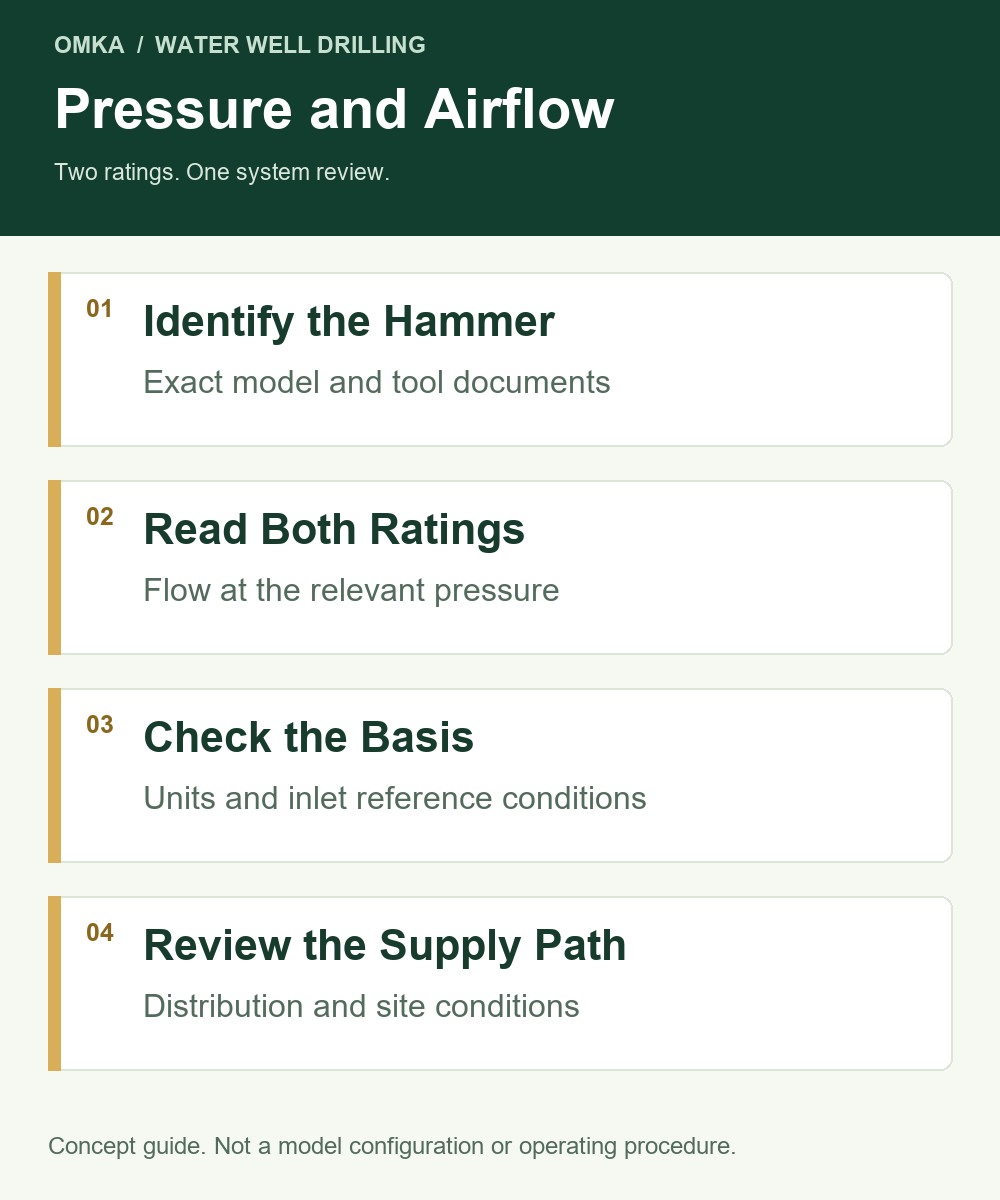
Pressure and Airflow Have Different Roles in Water Well DTH Drilling
What Working Pressure Describes
The working-pressure field describes a pressure associated with the compressor’s specified operating arrangement. It needs units and context. A buyer should know whether a listed value identifies the relevant working rating, another operating point or a different limit stated in the equipment documentation.
The DTH hammer also has its own operating information. Its requirements should be obtained for the actual tool model, not inferred from a broad size description. A statement that a compressor produces a certain pressure is not proof that every hammer can use that supply or that the whole installation is suitable.
Pressure at different locations in the system is another distinction. The compressor outlet, distribution equipment and bottom tool are connected through a real flow path. A catalogue rating at the supply unit should not be casually described as the pressure available at the hammer.
What Airflow Describes
Airflow is the quantity of air expressed per unit time on the stated measurement basis. In a water well DTH arrangement, the review includes the tool’s air demand and the circulation task. It also includes the conditions under which the compressor’s flow is rated.
Pressure and flow should be read together. An impressive flow figure without its corresponding pressure and reference conditions is incomplete for comparison. Likewise, a high-pressure figure without the available flow at the relevant operating point does not describe the whole supply.
Think of the two fields as separate answers to separate questions. What pressure range is relevant to the tool and system? What quantity of air is available on the stated basis at that duty? Answering only one leaves a gap in the selection.
Start With the DTH Hammer and Borehole Requirements
The hammer, bit and connected drill string should be identified before a specific compressor is recommended. A model designation helps locate the correct documentation. Drawings, connections and relevant operating information provide a stronger basis than appearance or a familiar product-family name.
Borehole diameter also belongs in the description. Together with the drill-string arrangement, it affects the geometry of the circulation path. The tool’s requirement is central, but the borehole task is broader than operating the hammer in isolation.
Depth needs to be included without becoming a shortcut for the whole assessment. As the task changes, the system review must account for the actual drilling arrangement and conditions. A universal table translating depth directly into compressor airflow leaves too many important inputs unstated.
Existing equipment should be documented in the same way as new equipment. If a contractor already owns a hammer, provide its exact details and documents. If the tools are still undecided, identify that as an open selection issue rather than fill the gap with a guessed air requirement.
Read the Compressor Rating Basis Before Comparing Numbers
Flow at the Relevant Working Pressure
A compressor specification may contain several values or operating conditions. Compare the flow information that belongs to the relevant working pressure and configuration. Do not combine the highest pressure from one line with the largest flow from another unless the documentation explicitly defines that pairing.
The distinction matters even when two suppliers use similar model names. An engine option, configuration or stated duty may differ. Keep the complete model and configuration description alongside the numbers so the comparison remains tied to the offered unit.
The same principle applies to a drilling rig’s advertised air requirements. Those fields are useful inputs, but they should not replace the documentation for the actual hammer and circulation arrangement. A range in a rig catalogue is not a complete compressor-selection calculation.
FAD, Units and Reference Conditions
Free air delivery, commonly abbreviated FAD, expresses delivered air in relation to stated reference inlet conditions. It should not be confused with the physical volume of compressed air moving through a pressurised hose. Atlas Copco’s explanation of air-compressor measurements describes this distinction. When comparing compressor capacities, establish what the manufacturer means and which conditions accompany the figure.
Some specifications use cubic metres per minute, while others use cubic feet per minute. Unit conversion makes numbers comparable only if their rating bases are comparable. Converting units does not resolve different reference conditions, uncertain test methods or missing operating-point information.
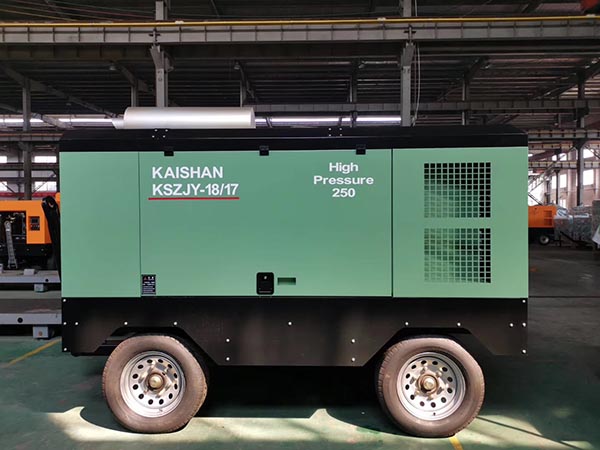
For example, the legacy KSZJ-18/17 specification lists a capacity of 18 m³/min and working pressure of 17 bar. Those are labelled catalogue figures, not a recommendation for a particular water well. The available source does not establish the flow test basis sufficiently to relabel that figure as confirmed FAD.
A careful buyer keeps the published label, requests the rating documentation and identifies the intended tool duty. This is more useful than presenting a precise converted number that conceals uncertainty about what was measured.
Swipe or scroll the table to compare all columns.
| Field | What to Establish | What the Field Does Not Prove Alone |
|---|---|---|
| Working pressure | Relevant rating and operating conditions | Compatibility with every DTH hammer |
| Airflow | Quantity, units and rating basis | Suitability for every borehole |
| Reference conditions | Basis used for the capacity figure | Actual conditions at the drilling site |
| Tool requirements | Exact hammer documentation | Completeness of the whole package |
| Configuration | Offered unit and equipment version | Equivalence to every unit in a series |
Include Site Conditions and the Air Distribution System
A compressor selected from a desk specification still operates at a real site. Ambient conditions, including temperature and altitude, should be communicated to the equipment supplier. Use the manufacturer’s relevant information to assess the configuration rather than applying a generic reduction percentage.
The air supply also passes through hoses, connections and the drilling assembly. Identify the proposed routing and the ratings of the equipment in that path. Connection descriptions should be precise enough to compare with the compressor, rig and tool interfaces.
Longer or more complicated distribution arrangements introduce questions that a bare compressor rating does not answer. The appropriate response is to review the actual system information, not to invent a universal hose size or pressure-loss allowance. The required assessment should follow the relevant technical documents.
Transport and placement matter as well. A compressor may be suitable on paper yet require a different site or transport arrangement from the one the buyer assumed. Include the supporting unit’s dimensions, weight and proposed position in the package planning, particularly where access is limited.
Check the Rig, Hammer and Compressor as One Package
Create a component list containing the rig configuration, drill rods, hammer, bit, compressor and air-distribution items. For each component, identify the relevant documents and the supplier responsible for resolving its interfaces. This prevents a system assembled from several quotations from falling between responsibilities.
The rig’s method support must be clear. Its ability to rotate and handle tools does not establish every possible DTH configuration. Review the selected rods, connections and bottom-tool arrangement against the offered machine’s documentation.
For the compressor, keep the relevant working pressure, flow label and configuration in the same record. For the hammer, keep the exact model and operating information. The comparison should connect those records to the actual borehole and distribution system rather than rely on a statement that both machines are sold for drilling.
A completed review should also identify customer-supplied items. If the contractor supplies hoses or tools, those components still need documentation. Excluding an item from the purchase price does not remove it from the technical system.
Keep the Measurement Location in the Record
A useful air-system record identifies where a value applies. Is it a compressor rating, a field observation at a stated location or information from the hammer document? These are different kinds of evidence and should keep their original descriptions.
Also preserve the pressure convention used in the document. Where a specification does not clearly identify its basis, request clarification rather than silently supply one. Numerical comparisons become more reliable when units, locations and conditions remain visible together.
This is particularly helpful when discussing existing equipment. A contractor’s recorded observation can provide context, but it should not be presented as a manufacturer’s rating or proof of conditions elsewhere in the system.
Common Misreadings of Air-System Specifications
One common mistake is treating higher pressure as an automatic upgrade. The relevant issue is the pressure information for the selected tool and arrangement. A number outside the context of those requirements says little about suitability.
Another mistake is assuming more flow makes every other limitation disappear. Rod handling, rotary capability, tool compatibility and the circulation path remain separate parts of the task. Buying a larger unit is not a substitute for identifying the actual constraint.
A third mistake is confusing the rig catalogue’s air range with a hammer-specific requirement. The catalogue may describe a broader capability or application context. The exact tools and their documents still belong in the assessment.
A fourth is using unit conversion to create false certainty. Changing m³/min into cfm does not confirm a missing test basis. Preserve the distinction between a calculated unit conversion and a verified rating for the offered configuration.
Finally, avoid reading photographs as interface documentation. A hose attached to a demonstration setup does not prove the pressure rating, connection standard or supply scope for the equipment being purchased.
A Hypothetical Comparison: Same Depth, Different Air-System Questions
Imagine two proposed water wells with the same target depth. One project already has identified tools and documented connections. The other has a different borehole diameter and has not yet selected its hammer. These are hypothetical purchasing situations, not recorded customer projects.
For the first task, the review can focus on the documented tool demand, compressor duty and distribution arrangement. For the second, recommending a compressor immediately would skip the unresolved tool selection and borehole assessment. The shared depth does not eliminate those differences.
This comparison helps buyers decide what to resolve next. Sometimes the missing item is a compressor document. Sometimes it is the tool definition or the overall circulation arrangement. Identifying that gap is a useful result even before a specific machine is proposed.
What Should You Send for a Water Well Air-System Review?
Provide the target borehole depth and diameter, available formation information and intended DTH arrangement. Include the exact hammer and bit details, drill rods and relevant connection drawings. If equipment is already owned, include its model and available rating documents.
Describe the site conditions and the proposed air-distribution route. Explain whether you need a compressor alone or a wider package including connections and supporting items. That boundary helps separate a technical matching question from a supply-scope question.
The existing air compressor enquiry guide provides a convenient way to organise these inputs. For tool interfaces, the drilling tool connections guide explains why exact identification matters.
Conclusion
Pressure and airflow are complementary fields in a water well DTH air-system review. Read them with their operating points, units and reference conditions, then connect them to the actual hammer, borehole and distribution arrangement.
A defensible comparison preserves the difference between published ratings, missing information and a verified package assessment. That approach makes equipment proposals clearer and reduces the risk of treating a catalogue number as a complete drilling solution.
Share the proposed hammer, borehole requirements, existing compressor documentation and site conditions through our contact page for a review of the air-system scope.